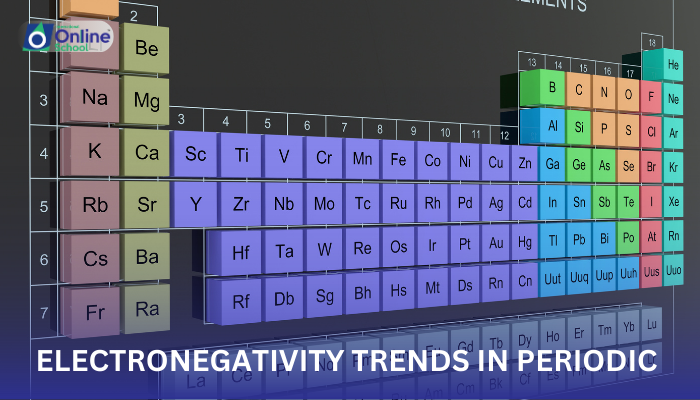
Lesson 10: Electronegativity Trends in the Periodic Table

Lesson 26/91 | Study Time: 30 Min
Course: Chemistry IX
Lesson 10: Electronegativity Trends in the Periodic Table

Learning Outcomes


By the end of this lesson, students will be able to:


i. Define and explain the concept of electronegativity, a measure of an atom's ability to attract electrons.


ii. Analyze how electronegativity values change within a group (top to bottom) and within a period (left to right) in the periodic table.


iii. Identify the factors that contribute to the observed trends in electronegativity across the periodic table.


iv. Apply the understanding of electronegativity trends to predict and explain the bonding behavior of elements.


v. Appreciate the significance of electronegativity in understanding the formation and polarity of chemical bonds.


Introduction


The periodic table, a comprehensive arrangement of elements, reveals a profound order, a pattern that reflects the underlying principles governing the properties and behavior of elements. Among these properties, electronegativity stands out, playing a crucial role in shaping the chemical landscape.


i. Electronegativity: A Measure of Electron Affinity


Electronegativity, a fundamental concept in chemistry, represents the ability of an atom to attract electrons in a chemical bond. It is a measure of an atom's electron-pulling power, reflecting its tendency to form polar or covalent bonds.


ii. Periodic Trends in Electronegativity


Electronegativity exhibits distinct trends within the periodic table:


Across a Period (Left to Right): Electronegativity generally increases from left to right across a period. This trend stems from the increasing nuclear charge as one moves towards the right side of the table, leading to a stronger attraction towards electrons.


Down a Group (Top to Bottom): Electronegativity generally decreases down a group. This trend arises due to the increasing shielding effect, where inner-shell electrons partially block the nucleus's positive charge, weakening its pull on the outermost electrons.


iii. Factors Influencing Electronegativity


Several factors contribute to the observed trends in electronegativity:


Nuclear Charge: The stronger the nuclear charge, the more tightly the electrons are held, resulting in higher electronegativity.


Distance from the Nucleus: Electrons closer to the nucleus experience a stronger nuclear attraction, leading to higher electronegativity.


Shielding Effect: Inner-shell electrons shield the outermost electrons from the nucleus's full charge, reducing electronegativity.


iv. Electronegativity and Bonding Behavior


Electronegativity plays a crucial role in determining the type of bonds formed between elements:


Polar Covalent Bonds: When atoms have different electronegativities, they form polar covalent bonds, where the electrons are not shared equally.


Ionic Bonds: In extreme cases where there is a significant electronegativity difference, an ionic bond is formed, with one atom losing an electron to become a positively charged cation and the other gaining an electron to become a negatively charged anion.


v. Significance of Electronegativity Trends


Understanding electronegativity trends is essential in chemistry:


Bond Polarity: Electronegativity determines the polarity of covalent bonds, influencing the distribution of electrons and the properties of molecules.


Chemical Reactivity: Electronegativity influences the reactivity of elements, with highly electronegative elements being more reactive.


Predicting Bonding Patterns: Electronegativity trends provide a framework for predicting the type of bonds formed between elements.


Electronegativity, a fundamental property of atoms, exhibits distinct trends within the periodic table, reflecting the interplay between nuclear charge, distance from the nucleus, and the shielding effect. By delving into these trends, we gain valuable insights into the bonding behavior of elements, their reactivity, and the formation of molecules, further enriching our understanding of the fascinating realm of chemistry.


Ayesha Khan

Ayesha Khan

Product Designer
Profile

Class Sessions

1- Lesson 01: Branches of Chemistry 2- Lesson 02: Differentiating Branches of Chemistry 3- Lesson 03: Matter and Substance 4- Lesson 04: Chemical Species 5- Lesson 05: Atomic Structure 6- Lesson 06: Classification of Matter 7- Lesson 07: Relative Atomic Mass 8- Lesson 08: Empirical Formula vs. Molecular Formula 9- Lesson 09: Atoms vs. Ions vs. Molecules vs. Molecular Ions vs. Free Radicals 10- Lesson 10: Mole Concept 11- Lesson 01: Rutherford's Atomic Model 12- Lesson 02: Bohr's Atomic Model 13- Lesson 03: Structure of the Atom 14- Lesson 04: Isotopes 15- Lesson 05: Electronic Configuration 16- Lesson 06: Subshells 17- Lesson 01: Understanding Periods and Groups in the Periodic Table 18- Lesson 02: The Periodic Law 19- Lesson 03: Classification of Elements Based on Electron Configuration 20- Lesson 04: Demarcation of s and p Blocks 21- Lesson 05: The Shape of the Periodic Table 22- Lesson 06: Location of Element Families 23- Lesson 07: Similarities within Element Families 24- Lesson 08: Electron Configuration and Element Position 25- Lesson 09: Shielding Effect and Periodic Trends 26- Lesson 10: Electronegativity Trends in the Periodic Table 27- Lesson 01: Valence Electrons and the Periodic Table 28- Lesson 02: Importance of Noble Gas Electronic Configurations 29- Lesson 03: Octet and Duplet Rules 30- Lesson 04: Attainment of Stability in Elements 31- Lesson 05: Formation of Bonds 32- Lesson 06: Noble Gas Configurations in Ion Formation 33- Lesson 07: Formation of Cations from Metallic Elements 34- Lesson 01: Defining Oxidation and Reduction (Oxygen/Hydrogen Perspective) 35- Lesson 01: Gas Pressure and Volume-Temperature Changes 36- Lesson 02: Physical States of Matter and Intermolecular Forces 37- Lesson 03: Boyle’s Law and Pressure-Volume Relationship in Gases 38- Lesson 04: Charles’s Law and Temperature-Volume Relationship in Gases 39- Lesson 02: Defining Oxidation and Reduction (Electron Perspective) 40- Lesson 05: Properties of Gases 41- Lesson 06: Properties of Liquids 42- Lesson 07: Effect of Temperature and Pressure on Vapor Pressure and Boiling Point 43- Lesson 08: Physical Properties of Solids 44- Lesson 09: Amorphous vs. Crystalline Solids 45- Lesson 10: Allotropic Forms of Solids 46- Lesson 03: Identifying Oxidizing and Reducing Agents 47- Lesson 04: Defining Oxidizing and Reducing Agents 48- Lesson 05: Defining Oxidation State 49- Lesson 06: Rules for Assigning Oxidation Numbers 50- Lesson 07: Determining Oxidation Numbers in Compounds 51- Lesson 08: Nature of Electrochemical Processes 52- Lesson 01: Relationship between Cations, Anions, Metals, and Non-metals 53- Lesson 02: Alkali Metals and Their State in Nature 54- Lesson 03: Identifying Alkali and Alkaline Earth Metals 55- Lesson 04: Ionization Energies of Alkali and Alkaline Earth Metals 56- Lesson 05: Sodium in the Periodic Table 57- Lesson 06: Calcium and Magnesium in the Periodic Table 58- Lesson 07: Soft vs. Hard Metals 59- Lesson 08: Inertness of Noble Metals 60- Lesson 09: Commercial Value of Noble Metals 61- Lesson 10: Important Reactions of Halogens 62- Lesson 11: Elements in Uncombined State in Nature 63- Lesson 09: Sketching an Electrolytic Cell 64- Lesson 10: Movement of Ions in Electrolytic Cells 65- Lesson 11: Uses of Electrolytic Cells 66- Lesson 12: Sketching a Daniel Cell 67- Lesson 13: Electrical Energy Production in Batteries 68- Lesson 14: Identifying Oxidation and Reduction in Voltaic Cells 69- Lesson 15: Differentiating Between Electrolytic and Voltaic Cells 70- Lesson 16: Preparation of Alkali Metals 71- Lesson 17: Manufacturing Sodium Metal from Fused NaCl 72- Lesson 18: Byproducts in Sodium Metal Manufacture 73- Lesson 19: Recovering Metal from Ore 74- Lesson 20: Electrolytic Refining of Copper 75- Lesson 21: Defining Corrosion 76- Lesson 22: Rusting of Iron 77- Lesson 23: Methods to Prevent Corrosion 78- Lesson 24: Electroplating of Metals on Steel 79- Lesson 01: Defining Solutions and Their Components 80- Lesson 02: Types of Solutions: Saturated, Unsaturated, and Supersaturated 81- Lesson 03: Formation of Solutions: Gases 82- Lesson 04: Formation of Solutions: Liquids 83- Lesson 05: Formation of Solutions: Solids 84- Lesson 06: Concentration of Solutions 85- Lesson 07: Molarity 86- Lesson 08: Preparing Solutions of Given Molarity 87- Lesson 09: Preparing Dilute Solutions from Concentrated Solutions 88- Lesson 10: Converting Molarity to g/dm³ 89- Lesson 11: The Rule of "Like Dissolves Like" 90- Lesson 12: Defining Colloids and Suspensions 91- Lesson 13: Differentiating Solutions, Suspensions, and Colloids